 DexSpeak
You open an English novel you have wanted to read for years. The first sentence has a word you do not know. The second has two. By the end of the first page you have opened a dictionary app eight times, and the story has slipped away. You close the book and promise to try again when your English is better.
This happens to almost every learner, and it is rarely about level. It is about how you look things up. Change that, and page one stops being the place where you give up.
Why English novels stop you on page one
The opening pages of a novel are the hardest part of the book. You do not know the characters yet, the writer is setting the scene, and the language is often at its most careful and literary.
A dictionary app makes it harder. You leave the page, type the word, and get a list of meanings. You choose one, go back, find your place and try to remember what the sentence was about. Each lookup costs half a minute and a little bit of the story. After a page of this, reading feels like work.
Look up a word without leaving the story
What you need is the meaning the word has in this sentence, right on the page. Take the famous first line of The Great Gatsby:
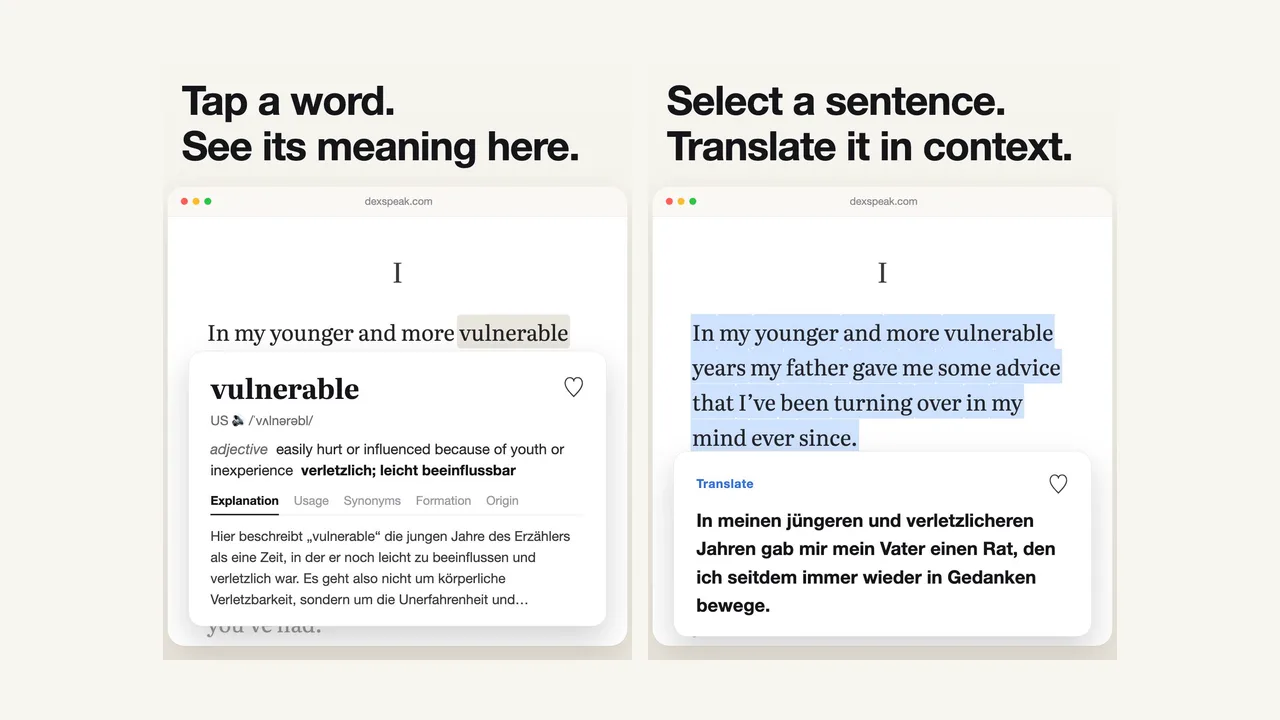
In my younger and more vulnerable years my father gave me some advice that I've been turning over in my mind ever since.
A dictionary lists several meanings for vulnerable. Here it means easily hurt or influenced, because the narrator was young and did not have much experience. It is not about being physically weak. Turning over in my mind is a phrase too: it means thinking about something again and again.
When you can tap vulnerable and see exactly that meaning, in a few seconds and without leaving the line, you go on reading with the sentence still in your head. That is also the moment the word is easiest to remember. For more on this, read how to tap any word as you read.
When the whole sentence is the problem
Sometimes you know every word and still cannot follow the sentence. The next line of Gatsby is a good example:
Just remember that all the people in this world haven't had the advantages that you've had.
Every word is simple, but the meaning is easy to get wrong. All the people haven't had does not mean that nobody has had these advantages. It means that not everyone has had them. This is where translating the whole sentence helps.
Use the translation as a check:
- Read the English sentence and try to understand it.
- Select the sentence and translate it into your language, in the context of the paragraph.
- Read the English once more and notice which part caused the problem.
The English stays at the center. The translation shows you the structure, and the second reading is where you learn it.
How many words should you look up on a page?
Only the ones that stop you from following the story. If you can guess a word from the sentence, or the sentence still makes sense without it, keep reading. You will meet the important words again.
If you find yourself stopping on almost every line, the book is too hard for now. That is not a failure; it is useful information. Choose something a little easier, or a book you already know in your first language, and come back later. For help with choosing, read how to read English books.
Keep the words you want, with their sentence
Some words are worth keeping. Save them together with the sentence where you met them, so that when you review, the scene comes back with the meaning. Keep the list short: the words that stopped you and the ones you would like to use yourself. To make those words stay, see how to learn vocabulary in context.
Read your first English novel with DexSpeak
This is the way of reading DexSpeak is built for. Upload your own EPUB book and open it on your phone, tablet or computer. Tap any word to see what it means in that exact sentence, with a short English definition and an explanation in your language. When a whole sentence is the problem, select it and translate it in context. Tap the heart to save what you find, together with its sentence. You can see the whole flow in the 21-second video on this page.
Start small: fifteen minutes a day with a book you chose because you want to know what happens next. Tap only what stops you, and let the story carry you to page two, then page ten. Learn English with whatever you love, and let the books you love be the first.