 DexSpeak

If you study medicine, nursing or radiologic technology in English and English is not your first language, you probably know this moment. You are halfway through a lecture recording or a textbook chapter, and one unfamiliar word stops you. You search for it, open three tabs, and by the time you come back, you have lost the thread of the explanation.
This is a normal part of studying a demanding subject in a second language. It does not mean you are behind. It means you need a way of handling new vocabulary that keeps you moving instead of stopping you every few minutes.
Why medical English feels harder than it should
Technical terms are only part of the problem. A term like pneumothorax is new to almost everyone, native speakers included, and your course will define it for you.
The harder part is often the English around the terms: the phrases, verbs and long sentences your lecturers and textbooks use to explain them. Look at this line:
The patient reported dyspnea on exertion.
Dyspnea means difficulty breathing. But on exertion is not a medical term at all. It is ordinary academic English for during physical effort, and if you miss it, you miss the point of the sentence: the breathing problem appears when the patient is active.
So when you build your vocabulary, pay attention to both layers: the technical terms and the everyday academic English that carries them.
Look up the word in its sentence
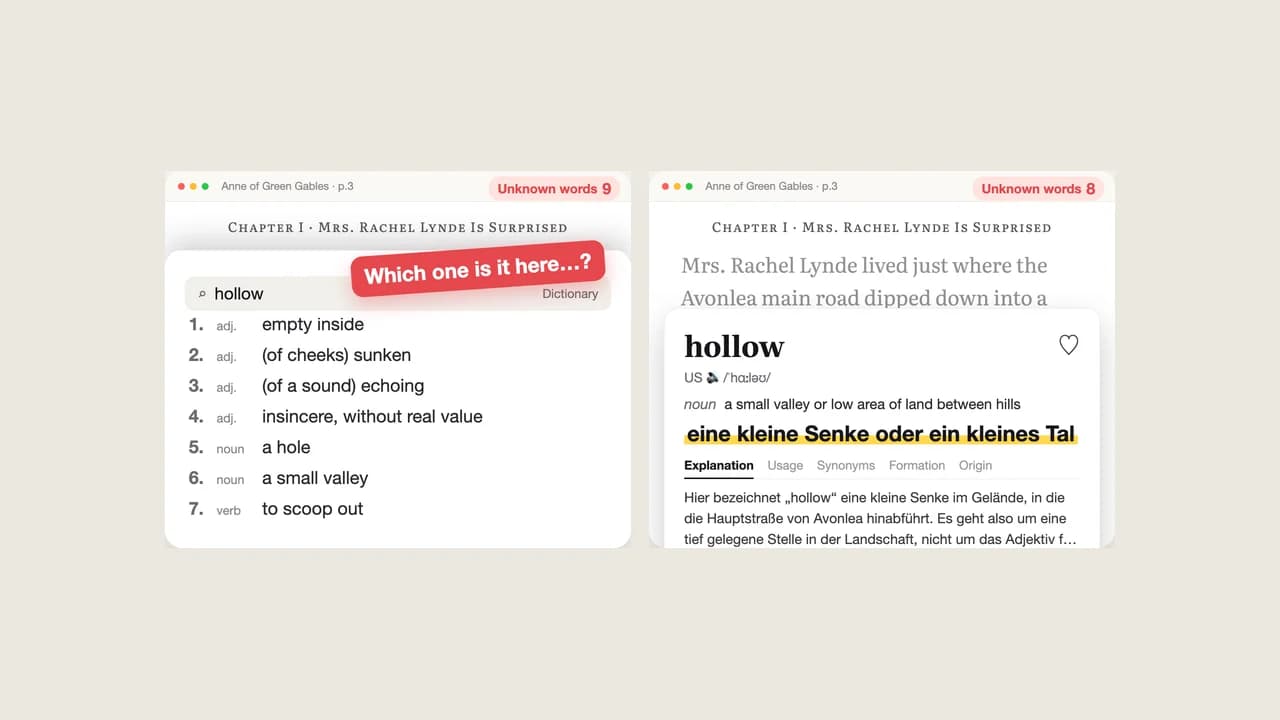
When you look up a word without its sentence, you often get a list of meanings and have to guess which one applies. Many words used in medicine also have everyday meanings: a culture can be a lab culture or a way of life, and a positive result is not always good news.
So look up the word in the sentence where you met it. Ask: what does it mean here, in this lecture, on this page? Then keep the sentence with the word. A note that says only dyspnea: difficulty breathing is easy to forget. A note with the full sentence reminds you how the word is actually used. For more on this approach, read how to learn vocabulary in context.
Learn phrases, not just single words
Much of the language in medical English comes in fixed groups of words. Here is another typical line:
A chest X-ray was ordered to rule out pneumonia.
Rule out means to show that something is not the cause. If you look up rule and out separately, the sentence makes no sense. Other common groups include present with, on examination, consistent with and side effect. Learn these as one unit, the way you would learn a single term.
Use word parts to check, not to guess blindly
Many medical terms are built from Greek and Latin parts. Knowing a few common ones helps a lot: hypo- means under or less than normal, hyper- means above or more than normal, cardio- refers to the heart, -itis means inflammation and -ology means the study of something. From these, terms like hypoglycemia, carditis and radiology become easier to read.
Word parts are a good first guess, but they are not proof. Always confirm the meaning in your textbook, glossary or with your instructor, especially for terms you will use in exams or clinical practice.
Build your own term list and review it
Generic medical vocabulary lists can be useful, but the words that matter most are the ones in your own lectures and readings. Keep one list for each subject. For each entry, write the term, a short meaning in your own words, and the sentence where you found it.
Then review it little and often: ten minutes a few times a week works better than one long session before an exam. When a word keeps coming back in new readings, that is a sign it is important.
Use educational videos with subtitles
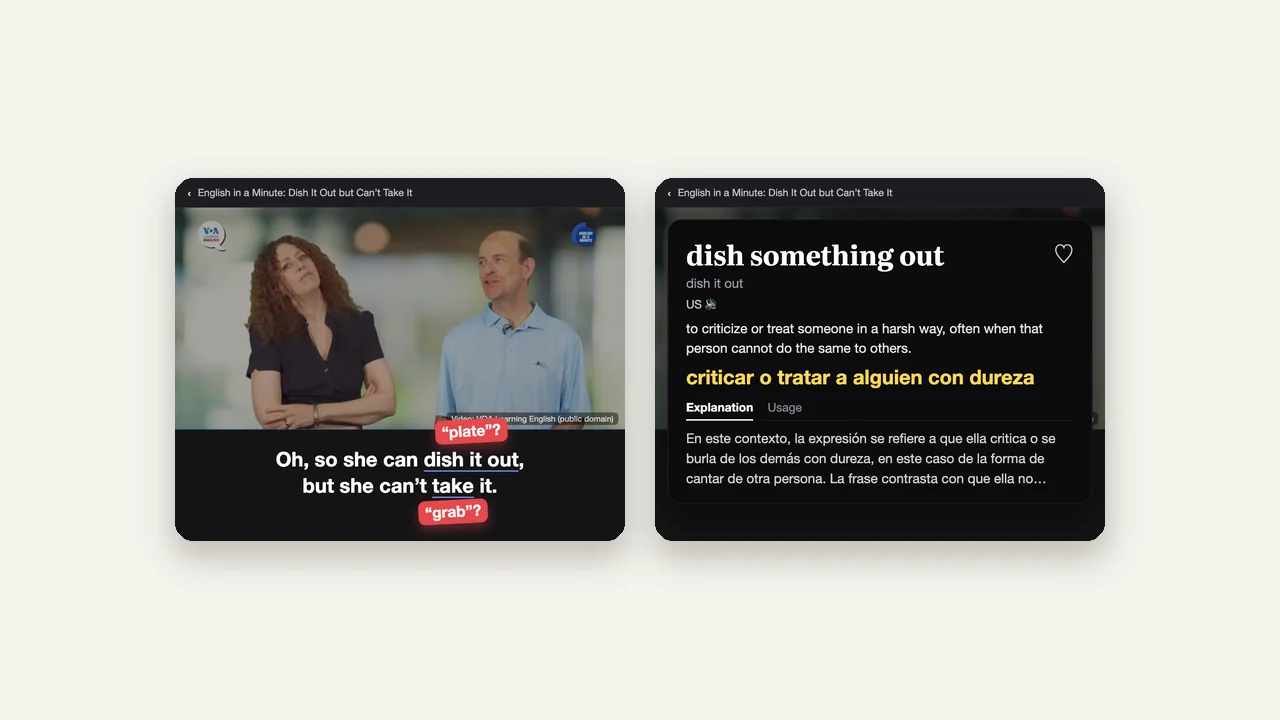
Short educational videos are a good way to meet terms and explanations in spoken English. Turn on English subtitles when they are available. Watch a section once for the main idea, then pause at the lines you did not follow, check the phrase in that sentence and replay it. For a step-by-step routine, read how to understand English YouTube videos.
Bao's story: a radtech student and DexSpeak
The video on this page comes from Bao (@baoco.daybook), a first-year radiologic technology student in the Philippines who keeps a video diary. In it, she describes the same problem this article is about:
As a medical student, especially when studying different subjects, I encounter a lot of English terms and concepts that require a little more understanding.
She then shows DexSpeak while watching an educational video: when she comes across a word or phrase she is not familiar with, she taps it, and DexSpeak gives an explanation right there, including its meaning and how it is used in context. Bao's video is a paid partnership with DexSpeak.
Where DexSpeak fits in your study routine
DexSpeak is built for the step this article keeps coming back to: understanding a word or phrase in the sentence where you found it. Open an educational video with English subtitles, an article or an EPUB book in DexSpeak, tap a word or phrase, and see what it means in that sentence, with a short English explanation and an explanation in your language. Save it, and it keeps its original sentence for your review list.
DexSpeak helps with the English. It does not replace your textbooks, lecturers or clinical references, so keep checking technical definitions against your course materials. Used that way, it can save you some of the stopping and searching, and leave more of your attention for the subject itself.