 DexSpeak

You may know plenty of English words, yet when someone asks, “Would you rather work from home or go to an office?”, all you can think of is I think and very good.
What you often need at that point is not a few obscure “big words”, but expressions that help you finish a thought: how to state your position, give an example and add, “Then again, it depends.”
Below are 100 useful IELTS Speaking words and phrases, grouped by ten purposes, with plain-English meanings, original examples and usage notes. This is a practice list, not a guarantee of band 7–9. Choosing expressions that relate to your experience and using them in your own answers is more useful than memorising the list in order.
Before you start: accuracy and naturalness matter more than sounding advanced
IELTS Speaking assesses fluency and coherence, vocabulary, grammar and pronunciation together. Vocabulary is only one part: using it accurately and appropriately helps more than deliberately choosing complicated expressions. To decide whether an expression suits you, ask: Do I know what it means? Can I use it in a complete sentence? Does this situation actually call for it?
For example, I usually go for a walk is a clear answer to a question about what you like doing at weekends. You do not need to turn it into a formal speech just to use an expression from a vocabulary list. Save comparisons, concessions and summaries for organising your thoughts on more abstract questions.
The ellipses in this article mean that you need to continue the sentence; linking words on their own generally also need ideas on both sides. The numbers are for reference, not a study sequence.
1. Giving opinions: explain how you see something (1–10)
- From my perspective... — From my point of view…
- I'm inclined to believe... — I tend to think…; more tentative than a firm conclusion.
- It strikes me that... — It seems to me…; something gives me this impression.
- What I find particularly interesting is... — What I think is especially interesting is…
- I have mixed feelings about... — I feel conflicted about…; I see benefits but also have concerns.
- I'm of the opinion that... — I believe…; fairly formal, and I think often works in everyday answers.
- To be perfectly honest... — To speak frankly…; useful when admitting how you really feel.
- If I had to choose... — If I were required to pick one…
- I'd argue that... — My view is…; follow it with a reason.
- In my experience... — Based on what I have experienced personally…; do not use it as a substitute for everyone else's experience.
I have mixed feelings about working from home. I enjoy the quiet, but I miss talking to my colleagues in person.
Here, mixed feelings has specific substance: quiet is a benefit, while the lack of face-to-face conversation is a concern. If you only say that your feelings are complicated without explaining them, the listener still does not know your view.
2. Gathering your thoughts: give yourself a moment to think (11–20)
- That's an interesting question... — I find that question interesting…; only use it if you really do.
- Let me think about that... — Give me a moment to consider that…
- Off the top of my head... — Without thinking about it in detail, my first answer would be…
- Now that you mention it... — What you just said reminds me…; it needs to relate to the other person's remark.
- Come to think of it... — On reflection…; now I think about it, I remember…
- Well, let me see... — Well, give me a moment to think…
- How should I put this... — How can I express this…; use it when looking for suitable wording.
- That's a tough one... — That is difficult to answer…
- I haven't really thought about it before, but... — I have not considered this carefully before, but…
- If I'm being completely honest... — If I say exactly what I really think…
Off the top of my head, I'd say the best thing about my neighbourhood is the park near my flat.
These expressions allow a brief thinking pause, but do not repeat the same opening for every question or string three of them together to stall. You still need to answer the question afterwards.
3. Connecting ideas: additions, contrasts and results (21–30)
- Furthermore — Also; fairly formal.
- Moreover — In addition; to add a further point; fairly formal.
- In addition to that — Besides that.
- What's more — Also; here is another point; useful for adding information in speech.
- Nevertheless — Despite that; however; fairly formal.
- On the contrary — The opposite is true; used to reject or correct a preceding judgement.
- Having said that — Even so; introduces a qualification to what you have just said.
- That being said — Even so; similar in purpose to the previous expression.
- On the flip side — Looking at the other side; fairly informal.
- Consequently — As a result; emphasises cause and effect; fairly formal.
The buses are cheap and fairly reliable. Having said that, they can get very crowded in the evening.
On the contrary and on the other hand have different uses. The latter presents another side of an issue; the former challenges a judgement. For example: Some people think the job is easy. On the contrary, it takes years of training. Do not use on the contrary simply because the next sentence describes a disadvantage.
Likewise, do not string furthermore, moreover and what's more together. Linking words explain the relationship between sentences; they are not decorations.
4. Expressing degree: make your judgements precise (31–40)
- To some extent — Partly; does not imply complete agreement.
- To a certain degree — Up to a particular point; partly.
- More or less — Roughly; approximately.
- By and large — Generally speaking.
- For the most part — In most cases.
- Relatively speaking — In relative terms; make the point of comparison clear.
- Comparatively — In comparison; often modifies an adjective or adverb.
- Substantially — To a large extent; by a large amount.
- Considerably — By quite a lot; noticeably.
- Marginally — Slightly; by a very small amount.
My current flat is considerably quieter than my old one, although it's only marginally bigger.
This sentence distinguishes two differences: much quieter, but only a little bigger. Considerably and marginally are not interchangeable simply because both can describe change.
5. Describing things: make adjectives informative (41–50)
- Compelling — Convincing or engrossing, as in a compelling argument or a compelling story.
- Innovative — Introducing new ideas or methods, as in an innovative approach.
- Exceptional — Outstanding or unusually good, as in exceptional service.
- Remarkable — Unusual or worth noticing, as in remarkable progress.
- Contemporary — Of the present time, as in contemporary art.
- Conventional — Usual or traditional, as in conventional teaching methods.
- Prevalent — Widespread, as in a problem that is prevalent in large cities.
- Authentic — Genuine or true to its origins; the exact meaning depends on context.
- Distinctive — Having a recognisable, individual character, as in a distinctive voice.
- Sustainable — Able to continue over time; can describe environmental issues or ways of doing things.
The café has a distinctive style: all the furniture is made from old wooden doors.
After saying distinctive, adding a visible feature is more specific than following it with very nice. Nor does conventional necessarily mean outdated, or contemporary necessarily mean innovative: those judgements are not built into the words.
6. Explaining and clarifying: make your meaning clear another way (51–60)
- What I mean by that is... — What I intend to say is…
- To put it another way... — To express it differently…
- In other words... — To say the same thing another way…
- The point I'm trying to make is... — What I am trying to explain is…
- What I'm getting at is... — What I really want to say is…
- The way I see it... — In my view…; expresses your interpretation, rather than necessarily rephrasing something.
- Let me elaborate on that... — Let me explain that in more detail…; fairly formal.
- To clarify... — To make this clear…; to remove a misunderstanding…
- More specifically... — To be more precise…
- That is to say... — In other words…; usually more formal than in other words.
I want a more flexible schedule. What I mean by that is being able to start work earlier and finish earlier.
Clarifying is not just repeating the same sentence. Here, explaining “flexible” through a specific arrangement lets the listener understand what you need.
7. Comparing and contrasting: put two options side by side (61–70)
- In comparison with... — Compared with…; followed by a noun or noun phrase.
- Similarly — In a similar way; highlights what two situations have in common.
- Likewise — In the same way.
- As opposed to... — Instead of…; in contrast to…
- Unlike... — Different from…; usually followed by a noun, pronoun or noun phrase.
- In contrast — By comparison; highlights a difference.
- Whereas — While; connects two contrasting clauses.
- On the other hand — Looking at another side; introduces another consideration.
- Alternatively — As another option; offers a different solution.
- Rather than — Instead of; the two things being compared should have suitably parallel grammatical structures.
My sister likes studying with music, whereas I need complete silence.
Note that unlike and whereas take different structures: Unlike my sister, I prefer silence. You can also say My sister likes music, whereas I prefer silence. Do not write Unlike my sister likes music.
8. Topic vocabulary: connect abstract nouns to your own life (71–80)
- Work-life balance — The balance between work and the rest of your life.
- Career prospects — Opportunities for future career development.
- Cultural diversity — The presence of a range of cultures.
- Social media influence — The effects of social media; the influence of social media is also common in sentences.
- Environmental impact — Effects on the environment, as in reduce the environmental impact of travel.
- Technological advancement — Progress in technology; technological advances can refer to several developments.
- Educational opportunities — Chances to access education.
- Economic development — Growth and development of an economy.
- Public transportation — Shared transport services; public transport is also common in British English.
- Healthcare system — The system for providing medical care.
Better public transportation would make it easier for people in my town to get to work without driving.
When faced with a broad topic, start with one example you can explain. For public transportation, discuss bus frequency, commuting distance or arrival times; for work-life balance, discuss whether you receive work messages at weekends. You do not need to pretend to know everything about a field.
9. Giving examples and support: make your point concrete (81–90)
- For instance — For example.
- Take... for example — Consider… as an example; put the thing you want to illustrate with in the middle.
- A case in point would be... — An example that illustrates the point would be…; fairly formal.
- To illustrate this... — To demonstrate this point…; fairly formal.
- This is evident in... — This can clearly be seen in…; follow it with an actual observation you can explain.
- A perfect example of this is... — A particularly fitting example is…; do not call something perfect if it does not fully fit.
- You can see this in... — This can be observed in…
- Evidence of this can be found... — Supporting evidence is available…; continue with where the evidence is or what it consists of.
- This is particularly true when... — This applies especially when…
- This manifests itself in... — This shows itself in…; fairly formal, with no need to force it into everyday answers.
Small changes can make a city more comfortable. Take my street, for example: the new trees provide shade on the walk to the station.
Present personal observations as personal observations. Do not invent studies, percentages or surveys to use evidence, or suggest that your one example applies to every city.
10. Summarising and closing: bring ideas together when needed (91–100)
- All things considered... — After considering all the factors…
- Taking everything into account... — Considering every aspect…
- On balance... — After weighing the different sides, overall…
- The bottom line is... — The most important point is…; fairly direct.
- Ultimately — In the end; at the most fundamental level.
- In conclusion — To conclude; more typical of the end of a formal speech or essay.
- To sum up... — To summarise…
- Overall — Looking at the whole picture.
- At the end of the day... — When everything is considered; a spoken idiom that can also literally mean the end of a day.
- When all is said and done... — Ultimately; after everything has been considered.
On balance, I'd rather live closer to work, even if the flat is a little smaller.
Do not force a conclusion onto a short answer. For a simple question about preferences, stating your preference and a reason is enough. After discussing the pros and cons of two options, on balance provides a more meaningful closing.
Using common little words well is more useful than constantly replacing them
Alongside these 100 items, pay attention to personally, actually, in fact, basically, generally, specifically, particularly, definitely and absolutely when you practise. They often appear in natural explanations and responses, but serve different purposes.
Actually often corrects an expectation, while in fact can add more specific information. For example:
I thought I'd dislike the early classes, but actually, I enjoy them. In fact, I've signed up for another one next term.
Specifically narrows the scope and identifies details; particularly highlights one item within a group. In particular, particularly is not inherently “more advanced” than especially. Choose according to meaning and collocation.
Definitely and absolutely can express certainty, but a strong tone does not make a well-supported argument. Obviously presents something as self-evident; if the other person might disagree, it can sound presumptuous. To be honest does not need to start every answer either.
Using these expressions naturally in an answer
Practice question: Would you prefer to work from home or in an office?
If I had to choose, I'd work in an office most days. I find it easier to ask quick questions when my colleagues are nearby. Take last week, for example: a five-minute conversation helped me solve a problem I'd been stuck on all morning. Having said that, I'd still like one day at home each week so I could focus on tasks that need more concentration.
This answer uses just three main expressions: If I had to choose states a preference, Take... for example introduces a specific experience, and Having said that adds a qualification. The rest explains the ideas.
Do not memorise this experience. Replace “a colleague helped me solve a problem” with something that actually happened to you; if you have not worked before, answer a question about studying at home or in a library instead. The goal is to keep speaking using familiar experiences.
Ten minutes a day: from understanding to speaking
Listen or read first, then take notes. Find a short piece of English content that interests you and notice how these expressions appear in real sentences. Choose just three to five at a time. Record the full sentence, the meaning in that context and common collocations, then add your own example. See how to learn vocabulary in context for more ideas.
Use the expressions with a new question. Choose a familiar topic and speak for thirty seconds to a minute. Do not insist on using all five expressions you have just learnt; use only one or two that really help. Listen back to a recording: Did you give an opening but no substance? Was a word's meaning right but its collocation unnatural? Did the ideas on either side of a linking word fit logically?
Try again a few days later. Without looking at your notes, choose a different question and speak again in your own words. For expressions you cannot produce, listen to the original sentence again, then shorten and simplify your own example. For further practice, see how to practise English speaking.
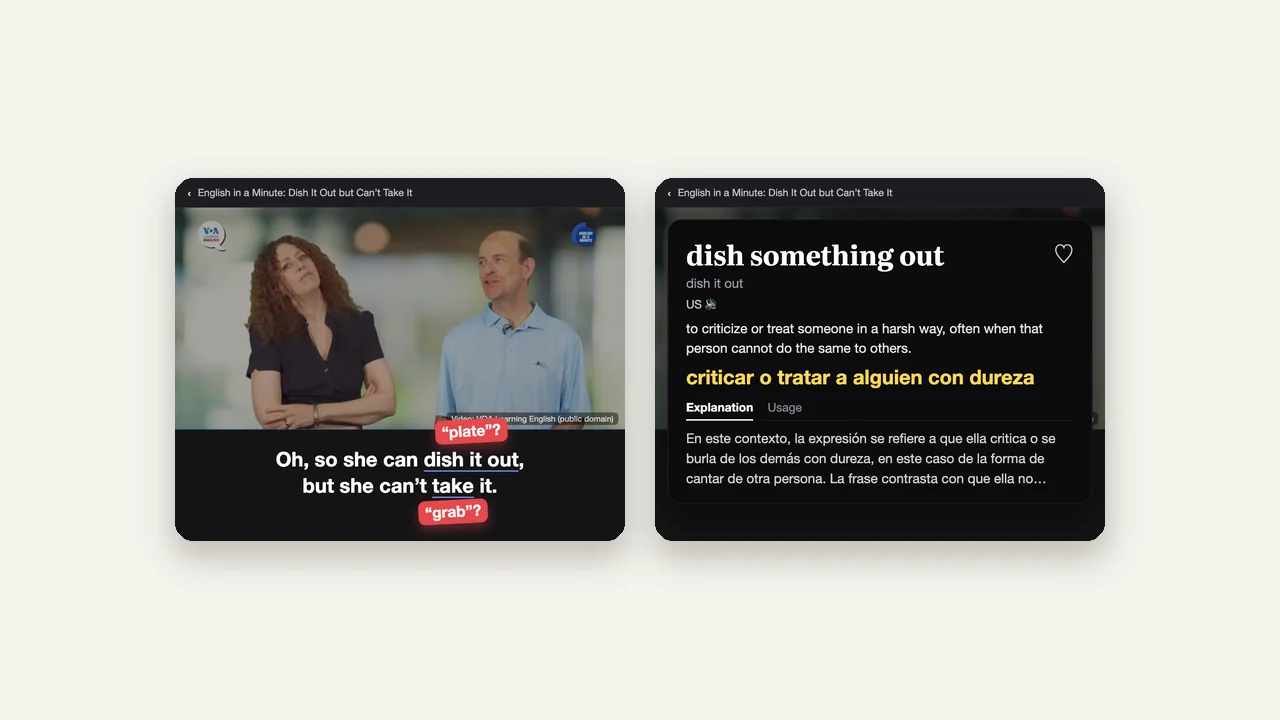
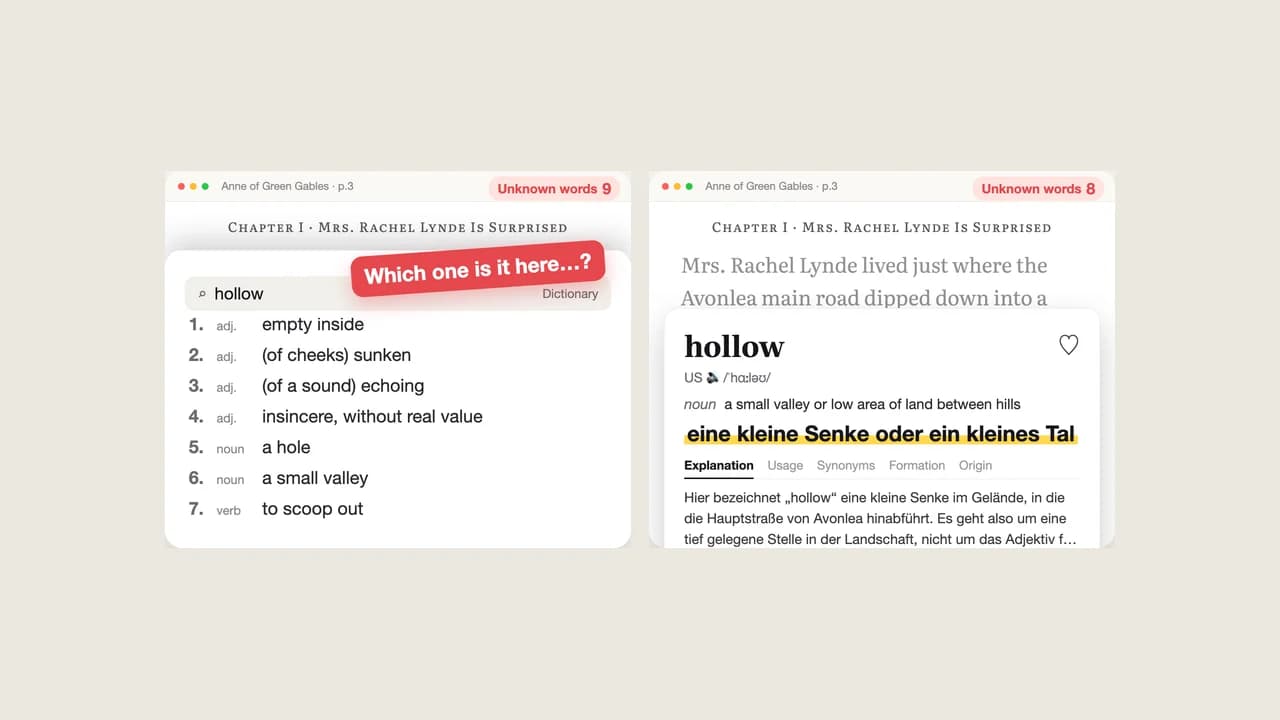
When reading articles or ebooks, or watching videos with English subtitles in DexSpeak, you can look up the meanings of words and phrases in context and save them with their original sentences. Then use your saved items as speaking prompts: first recall the meaning, then say a sentence about yourself. The tool helps you understand and save; speaking practice still requires you to speak.
Choosing three expressions you most want to use today is enough. What you are building is English you can use when the moment calls for it.