 DexSpeak
You have studied English for years. You know the grammar and thousands of words. Then you open an English video on YouTube, two people start talking, and the line that makes everyone laugh goes straight past you.
You replay it. You can even read every word in the subtitles. It still does not make sense.
The problem is rarely your vocabulary. It is that natural English is full of phrases whose meaning is not the sum of their words.
A line where you know every word
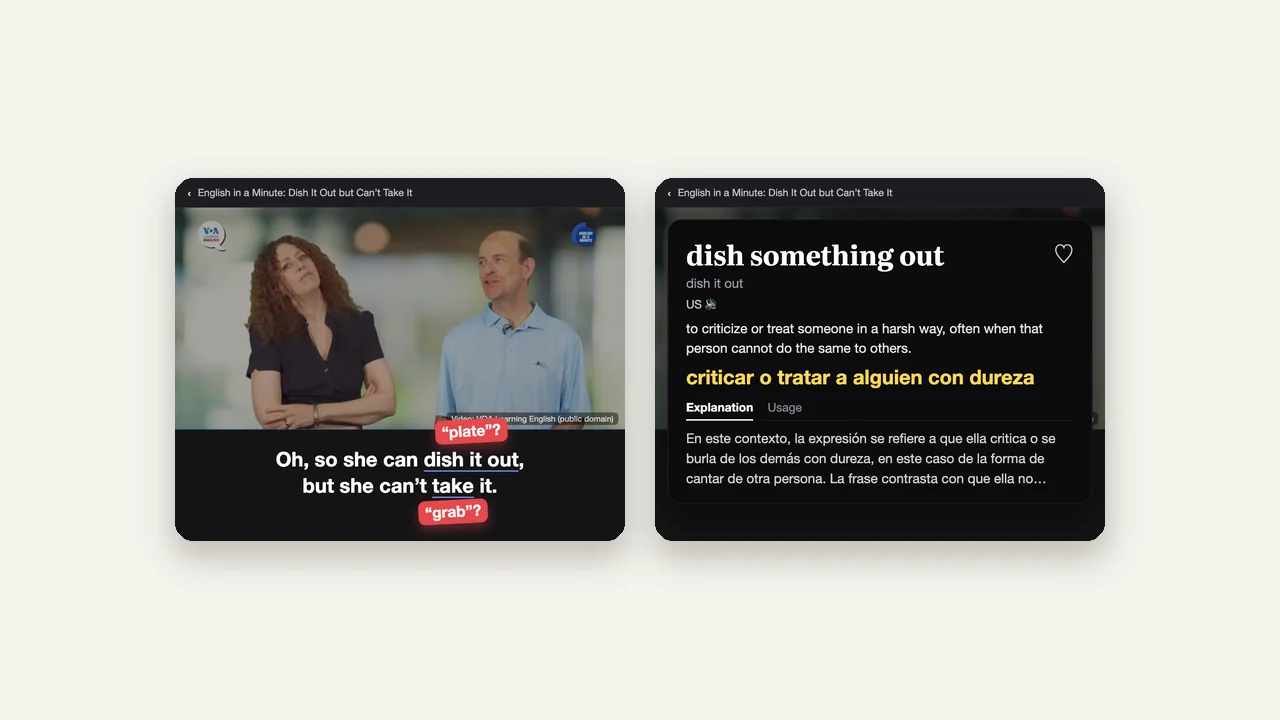
Here is a line from a short VOA Learning English video. A woman explains that her friend Dee joked about her piano playing, so she joked back about Dee's singing, and Dee got angry. The man she is talking to replies:
Oh, so she can dish it out, but she can't take it.
Dish is a plate, or a meal. Out is easy. Take is one of the first verbs anyone learns. If you translate word by word, you get something about serving plates and not being able to take them, and the line stops making sense.
Together, the words mean something else. Dish it out means to criticize, tease or treat other people harshly. Take it means to accept the same treatment calmly. So the line means: she is happy to criticize others, but she gets upset when someone does it to her.
Why videos are harder than textbooks
Textbooks and graded readers mostly use words in their basic meanings. Real conversations, vlogs and shows use what native speakers actually say, and that includes a lot of idioms and phrasal verbs: dish it out, take it, figure out, put up with, come across, get away with.
Videos add a second problem. In fast, connected speech, small words blend together. Dish it out can sound like one word, and can't take it can lose most of its sounds. For more on that side of the problem, read how to improve English listening.
So a line in a video can fail you twice: you may not hear it clearly, and even when you do, the meaning is hidden inside a phrase.
How to notice a phrase
When a line confuses you, ask three quick questions:
- Do I know every word, but the line still makes no sense? That is the clearest sign of an idiom or phrasal verb.
- Is a verb followed by a small word like out, up, off or it? Dish it out, take it and figure out all follow this pattern.
- Does the literal meaning not fit the scene? Nobody is serving food in this conversation, so dish cannot mean a plate here.
If the answer to any of these is yes, look up the group of words as one unit, not each word on its own. A dictionary entry for dish will start with plates and meals. The meaning you need lives under the phrase.
Pause, tap, replay
This simple routine turns any short video into listening practice:
First, watch the clip once without stopping, just to follow the situation. Then go back to the line you missed and pause there. Check what the phrase means in that scene, not in general. Then replay the line with English subtitles and your own language together, so you can match each part of the English to its meaning. Finally, replay it a few more times with English only, until you can hear every word.
One line understood this deeply is worth more than ten minutes of video you only half followed. Save the phrase together with its sentence, so you remember where you met it. For more on learning words this way, read how to learn vocabulary in context.
Choose videos you can replay
Short clips work better than long episodes. A one-minute video you watch five times teaches you more than a whole episode you watch once.
Choose videos you would enjoy even in your own language: a vlog about something you like, a cooking channel, a short interview, an English-learning channel that explains one expression at a time. If you enjoy it, replaying it feels natural instead of boring. For ideas, see learn English through what you love.
Watch English videos with DexSpeak
This is the way of watching DexSpeak is built for. Open a YouTube video in DexSpeak and its English subtitles appear under the video. Phrases and idioms are underlined; tap one, like dish it out, to see what it means in that line, with a short English definition and an explanation in your language. Turn on subtitles in English and your language together, replay any line with one tap, and save phrases with the sentence you found them in.
The 22-second video on this page shows the line above from VOA Learning English, a public domain video: one tap on dish it out, then the same scene again with subtitles in both languages.
You do not need to understand every word of every video. You need the meaning of the phrases that matter, and the patience to replay the line until you can hear it.