 DexSpeak
You open Anne of Green Gables, a story you have loved since childhood, and the first sentence is already a wall of words you do not know. You look one up. The dictionary gives you seven meanings. By page three you have spent more time in the dictionary than in the book, and you close it.
The problem is rarely your level. It is that a dictionary answers a different question from the one you are asking.
One word, seven meanings
Here is how the novel begins:
Mrs. Rachel Lynde lived just where the Avonlea main road dipped down into a little hollow, fringed with alders and ladies' eardrops and traversed by a brook that had its source away back in the woods of the old Cuthbert place.
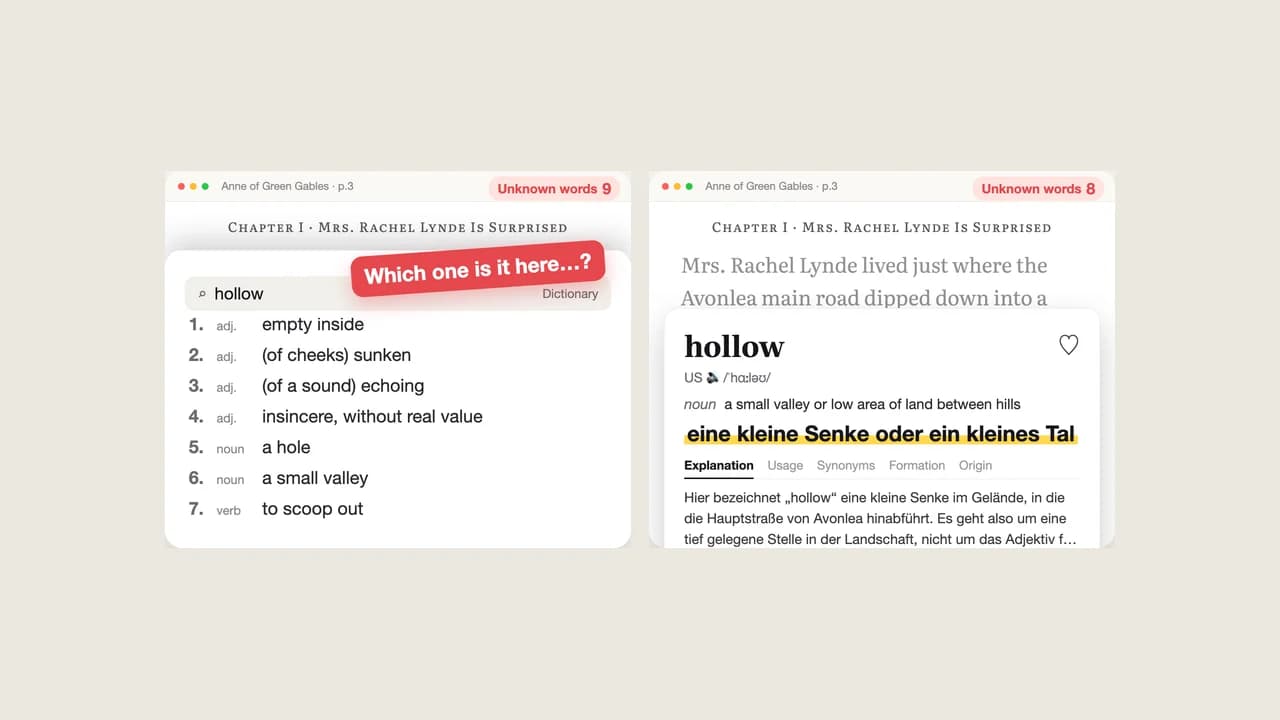
Look up hollow and a typical dictionary lists something like this: empty inside, sunken, sounding empty, insincere, a hole, a small valley, and to scoop out. Seven meanings, and the first one you see is empty inside.
In this sentence hollow is none of the first four. It is a small low area of land between hills, a little valley that the road dips down into. If you stop at the first meaning, the sentence stops making sense.
Why the first meaning is so often wrong in novels
A dictionary orders meanings by how common or how basic they are, not by what your text needs. Everyday English uses hollow most often for things that are empty inside, so that meaning comes first.
Novels, and older novels in particular, love the less common meanings. They describe landscapes, old houses and people's habits in words that were ordinary a hundred years ago. The result is that the meaning you need is often number five or six on the list.
How to find the right meaning from the sentence
Before you choose a meaning, ask the sentence three questions:
- What kind of word is it here? A little hollow has a before it, so here it is a noun, a thing.
- What is around it? The road dipped down into it, so it is a place you can go down into.
- What picture is the sentence painting? A road, a brook and trees along the edge: this is a landscape.
A noun, a place you can go down into, in a landscape: a small valley. The sentence tells you the meaning; the dictionary only gives you the options. For more on learning words this way, read how to learn vocabulary in context.
Which unknown words you can skip
The first page of Anne of Green Gables has many words most learners do not know: hollow, fringed, alders, traversed, brook, reputed, headlong, decorum, ferreted. You do not need all of them equally.
Alders and ladies' eardrops are plants. Knowing that something grows along the edge of the valley is enough; the story does not depend on which plant. Brook and hollow come back again and again, so they are worth knowing. Words like ferreted, as in she would never rest until she had ferreted out the whys and wherefores, tell you something about Mrs. Rachel's character, so they are worth a quick look.
A simple rule: look up the words that stop you from following the story, and let the rest go. You will meet the important ones again.
When the whole sentence is the problem
Some sentences are hard even when you know the words. The next part of the same sentence is a good example:
It was reputed to be an intricate, headlong brook in its earlier course through those woods.
Reputed to be means that people said it was like this. Headlong means rushing forward fast and without control. The writer is having fun: the brook is wild in the woods, but becomes quiet and polite by the time it passes Mrs. Rachel's door, because nothing would dare to behave badly in front of her.
When a sentence like this stops you, translate the whole sentence once, then read the English again. The translation shows you the structure; the second reading is where you learn it. For more on reading this way, see how to read English novels without a dictionary app.
Read Anne of Green Gables with DexSpeak
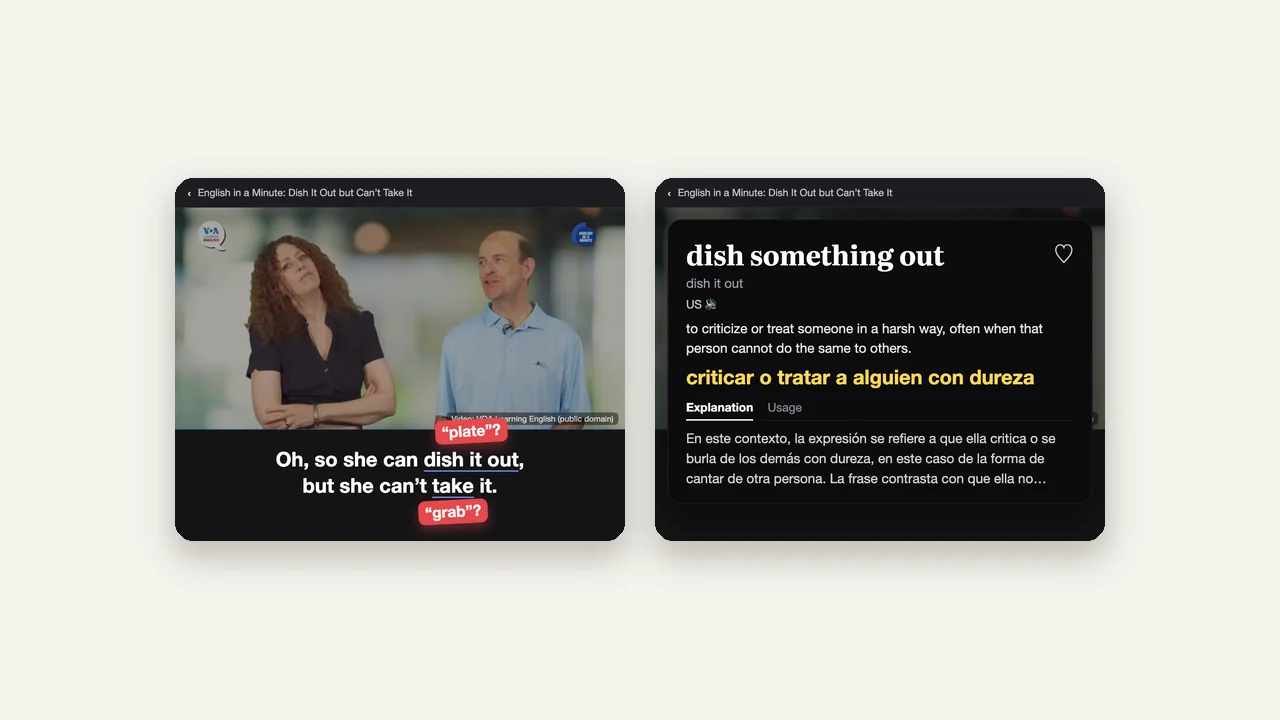
This is the way of reading DexSpeak is built for. Anne of Green Gables is in the DexSpeak library, and you can also upload your own EPUB books. Tap any word to see the meaning it has in that exact sentence, with a short English definition and an explanation in your language, not a list of seven meanings. When a whole sentence is the problem, select it and translate it in context. Save the words you want to keep, together with their sentence. The 27-second video on this page shows nine unknown words on page three cleared one tap at a time.
You do not need to understand every word to enjoy a book. You need the right meaning for the words that matter, quickly, and the patience to turn the page. For choosing what to read next, see how to read English books.